Schema Health
A deterministic Schema.org audit of every product's JSON-LD — no AI tokens, included on every plan.
Last updated July 5, 2026
Schema Health is a structured-data audit of the active catalog. For every product, Lumio validates the JSON-LD captured during the last import against Schema.org’s Product requirements, Google’s merchant expectations, and the fields AI agents rely on. The audit is pure computation — no API calls, no AI tokens — and it’s included on every plan, including Free.
Open Schema Health in the sidebar (under Content) to run it. Results are recomputed every time the page loads.
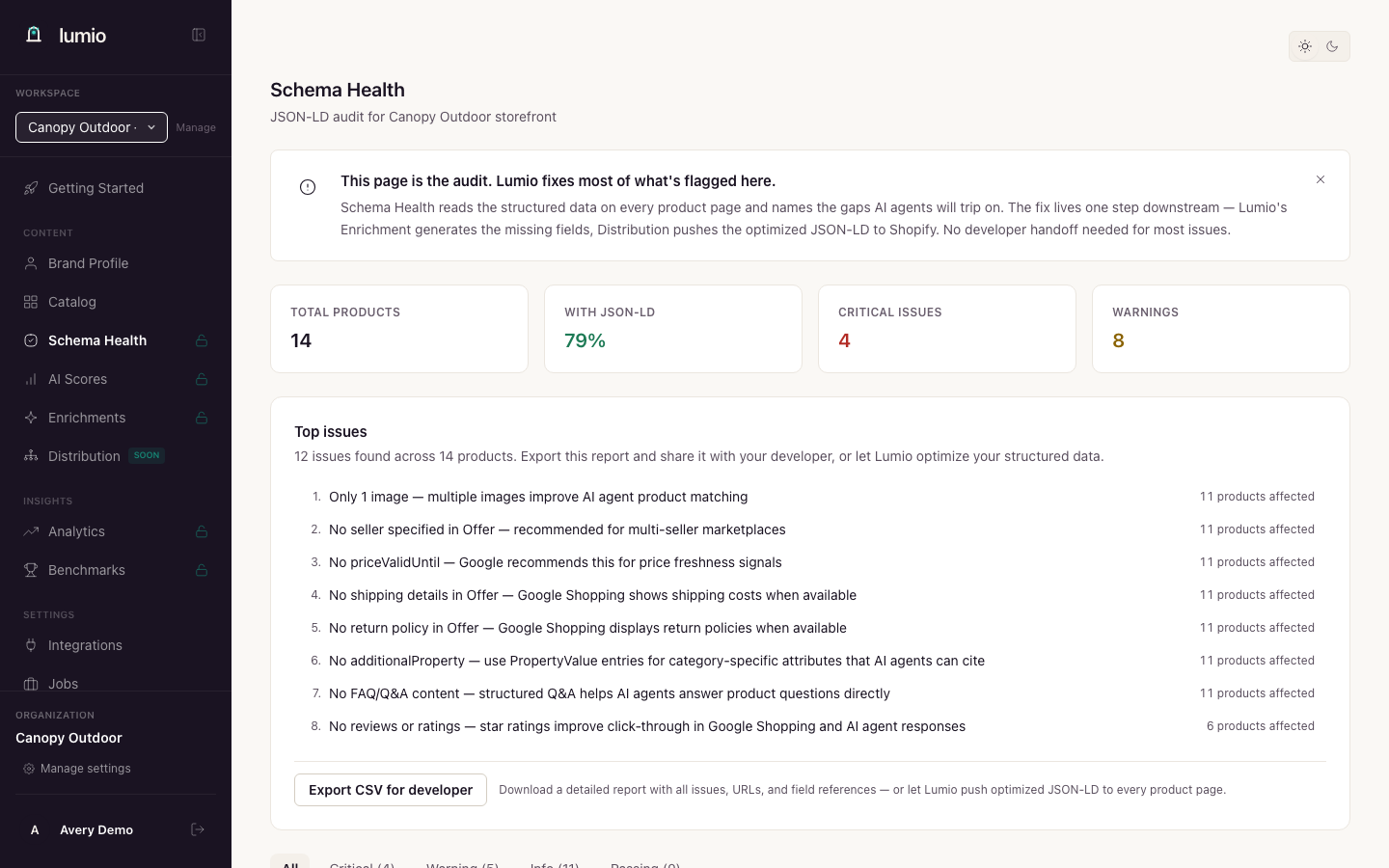 Schema Health grades every product’s structured data and ranks the most common gaps — no AI tokens, included on every plan.
What it audits
Schema Health reads the JSON-LD stored when the catalog was imported — the same <script type="application/ld+json"> data captured during a sitemap scan or Shopify sync. It does not fetch live pages. If a product page has been fixed since the last import, re-import the catalog to see the change reflected.
Severity levels
Every issue carries one of three severities, plus a tag showing which system cares about it:
| Severity | Meaning |
|---|---|
| Critical | AI agents or Google can’t reliably read the product at all — missing JSON-LD, no Product type, no price, no image, no product name |
| Warning | The product is readable but weaker than it should be — short descriptions, missing brand, no GTIN, non-standard availability values |
| Info | Discoverability opportunities — no SKU, no category, no material or color attributes, no FAQ content, single product image |
The Applies to column marks each issue as relevant to Google, AI, or Both. Products with no issues show a Pass badge.
Two details worth knowing:
- If a product has no JSON-LD at all (or none with a Product type), the audit reports that single critical issue and stops — the remaining checks can’t run without a Product block. Fixing the blocking issue and re-importing can reveal further findings, so issue counts sometimes rise before they fall. That’s the audit getting deeper, not the page getting worse.
- The summary cards count issues; the filter chips count products that have at least one issue of that severity. The two numbers answer different questions.
Reading the results
The page opens with four summary cards — total products, the share with JSON-LD, critical issues, and warnings — followed by a Top issues list ranking the most frequent problems by how many products each affects.
Below that, every product in the catalog is listed with its issue count and worst severity. Filter by severity (All, Critical, Warning, Info, Passing), sort by issues, severity, or name, and expand any product to see its full issue table with the affected field and a link to the live product page.
CSV export
Export CSV for developer downloads schema-health-audit.csv with one row per issue: product, URL, severity, issue, and the affected field. Products without issues are excluded. Useful for handing a fix list to whoever maintains the storefront theme.
Fixing what’s flagged
Schema Health is read-only — it never changes product data. The fix paths:
- Enrichment generates the content fields the audit flags as missing — descriptions, attributes, Q&A content.
- Shopify delivery pushes enriched fields back to the storefront, where the theme extension renders them as JSON-LD. This is part of the Distribution area, which is still rolling out (marked Soon in the sidebar).
- The CSV export covers everything else — theme-level fixes like malformed offers or missing currency codes belong to the storefront developer.
Delivery is included on the Professional plan and above; the audit itself is free on every plan.
Schema Health vs. AI Readiness Score
Two different reads on the same catalog. Schema Health is a deterministic rules check on structured data — instant, free, mechanical. The AI Readiness Score is an AI evaluation of how well the product reads to a shopping agent — it runs as a background job and consumes plan capacity. Run Schema Health first: fixing critical structured-data issues before scoring makes the scores more accurate.