AI Readiness Score
The AI Readiness Score is a 0–100 metric that measures how prepared each product is for AI shopping agents like ChatGPT, Perplexity, and Google AI Mode — across seven dimensions of content readiness.
Last updated July 5, 2026
The AI Readiness Score is a per-product metric from 0–100 that measures how well a product’s content and structured data are prepared for AI shopping agents like ChatGPT, Perplexity, and Google AI Mode. It’s the single agent-readiness signal Lumio surfaces for every product in a catalog: where each one stands today, and exactly what to fix first.
The score is sometimes called agent readiness, AI content readiness, or AI discoverability in the industry. Lumio uses AI Readiness Score as the canonical name because it captures both halves of the problem: the content quality the agent reads, and the structural completeness it needs to act with confidence.
Why it matters for AI agent discoverability
When an AI shopping agent decides which products to recommend, it evaluates the structured data and content depth available for each one. Products with rich, well-organized data get recommended. Products with thin data get skipped — no matter how good the actual product is.
The AI Readiness Score names exactly where each product stands and what to fix.
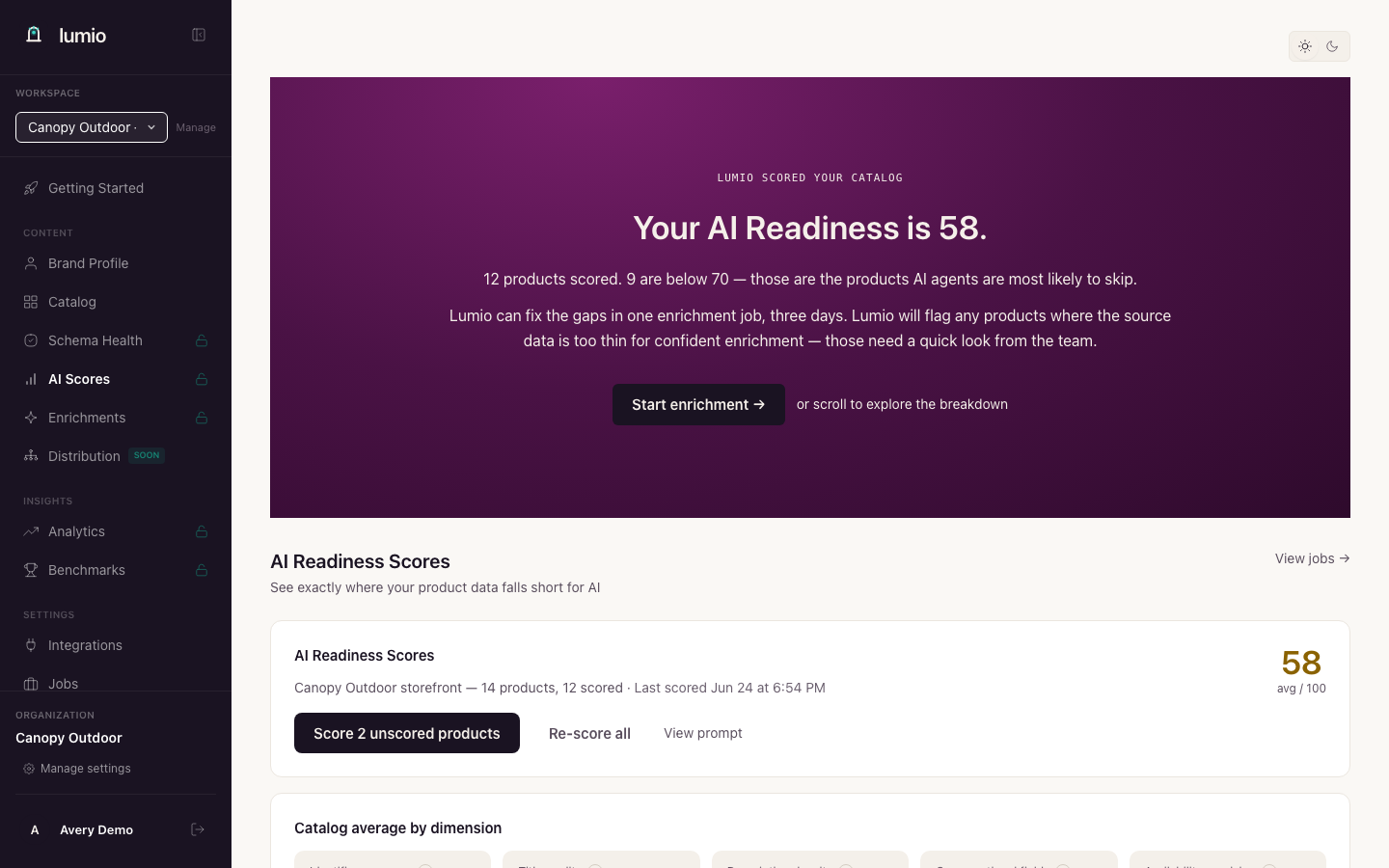 Every product gets a 0–100 AI Readiness Score. The catalog average and the weakest dimensions surface first.
Scoring runs as a background job through Anthropic’s Message Batches API for cost-efficient bulk processing. Products are batched at 500 per request. An email arrives when scoring finishes. If a job is interrupted, the next run resumes from the last completed product — no work is lost.
Dimensions
Six core dimensions evaluate every product. A seventh dimension, Brand alignment, joins the mix when the workspace has at least one active voice rule — when it does, the other six rebalance to make room.
| Dimension | Weight | What it measures |
|---|---|---|
| Identifier coverage | 15% | GTINs, MPNs, brand, model numbers — the identifiers that help AI agents match products across sources |
| Title quality | 20% | Structured format: brand, product type, key attribute, variant — not marketing slogans |
| Description density | 20% | Attribute-rich content that answers implicit questions: materials, dimensions, use cases, compatibility |
| Conversational fields | 20% | Q&A pairs, usage scenarios, and compatibility notes that match how shoppers query AI assistants |
| Availability precision | 10% | Exact quantity, handling time, and replenishment date |
| Schema completeness | 15% | Product, Offer, and Review JSON-LD markup quality |
The six core weights sum to 100%. When Brand alignment is active it takes 14% and the six core dimensions rebalance to make room (roughly 12 / 18 / 18 / 18 / 8 / 12), so the total always sums to 100%.
Score ranges
- 0–39 (Needs attention) — Products are effectively invisible to AI agents. Critical structured data is missing.
- 40–69 (Fair) — Partial visibility with significant gaps. AI agents may find these products but can’t confidently recommend them.
- 70–100 (Good) — Competitive for AI-powered discovery. Products have the data density AI agents need.
How scores are calculated
Each dimension is scored independently from 0–100. The scoring model reads the product’s raw data (titles, descriptions, JSON-LD, meta tags) and evaluates it against the dimension’s criteria.
The brand profile — vertical, brand personality, customer persona — is included as context. A hiking boot is evaluated differently than a lipstick; the attributes that matter are vertical-specific.
The overall score is the weighted average across the active dimensions.
Gap reports
For any dimension scoring below 70, Lumio generates a gap report with:
- Specific issues — What’s missing or weak (“No GTIN identifier found”, “Title is generic and lacks key attributes”)
- Actionable suggestions — Exactly what to add (“Add material composition and fit information to description”)
These gaps feed directly into the enrichment engine, which generates the missing content.
Schema Health vs. AI Readiness Score
Two different reads on the same catalog:
- AI Readiness Score is an AI-judged evaluation of how a product reads to a shopping agent. It uses tokens and runs as a batch job.
- Schema Health is a deterministic Schema.org audit of the JSON-LD captured during scanning. It uses no tokens and is computed instantly at page load — no scoring job required.
Both are useful — Schema Health catches mechanical issues (missing GTIN, malformed offers, duplicate Product blocks) instantly. The AI Readiness Score asks the harder question: even with valid markup, would an AI agent find this product worth recommending?
Improving scores
The fastest paths:
- Run enrichment — Enrichment reads each product’s score breakdown and gap report as context, then generates the missing content.
- Add structured data — Ensure product pages have valid JSON-LD Product schema. Schema Health flags exactly what’s missing.
- Add identifiers — GTINs/UPCs, MPNs, brand, model on every product.
- Write for AI, not just humans — Include the specific attributes (materials, dimensions, compatibility) that AI agents use to match products to queries.